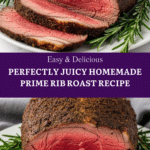
Homemade Prime Rib Roast Recipe
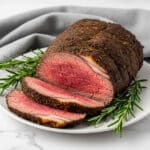
This Homemade Prime Rib Roast recipe delivers tender, juicy, and flavorful prime rib with a simple herb crust of fresh rosemary, thyme, and garlic. Perfect for special occasions, this easy method uses low and high oven temperatures and a meat thermometer to achieve a perfect medium-rare roast with minimal fuss, allowing you to impress guests with a restaurant-quality centerpiece.
- Prep Time: 4 hours 30 minutes
- Cook Time: 3 hours 45 minutes
- Total Time: 8 hours 15 minutes
- Yield: 4 servings 1x
- Category: Main Course
- Method: Baking
- Cuisine: American
Ingredients
Scale
For the Roast:
- 1 bone-in prime rib roast (room temperature before cooking, about 4–6 pounds)
- 1/3 medium onion, diced
For the Marinade per Pound of Roast:
- 1 tsp fresh rosemary (finely chopped)
- 1 tsp fresh thyme
- 1 tsp kosher or coarse sea salt (freshly ground preferred)
- 1/2 tsp olive oil
- 1 tsp minced garlic
- 1/2 tsp ground black pepper
Other:
- 1 to 1.5 cups water (added in increments during roasting)
- Optional: splash of red wine for au jus
Instructions
- Prepare and Marinate the Prime Rib Roast: Rinse the bone-in prime rib roast under cold water and pat dry thoroughly with paper towels. In a bowl, combine kosher or coarse sea salt, ground black pepper, minced garlic, freshly chopped rosemary, thyme, and olive oil to form a paste. Rub this seasoning paste all over the roast, ensuring an even coating. Cover with plastic wrap and refrigerate overnight, or at least 8 hours, to allow the flavors to deeply infuse into the meat.
- Bring Roast to Room Temperature and Set Up the Roasting Pan: Remove the marinated roast from the refrigerator about 2 hours before cooking to bring it closer to room temperature for even cooking. Place a flat roasting rack inside a large roasting pan or alternatively spread diced onions directly on the pan surface. Arrange the roast on top of the diced onions, which act as a natural roasting rack and flavor enhancer.
- Begin High-Temperature Roasting: Preheat your oven to 450°F (230°C). Position the roasting pan with the roast on a lower oven rack to minimize burning risk. Roast for 30 minutes at this high temperature. After 30 minutes, carefully add 1/2 cup of water to the bottom of the pan to help onions caramelize and prevent drippings from burning. Continue roasting for another 30 minutes, turning the roast 180° halfway through to promote even browning. Adjust roast position if any side isn’t browning evenly, directing it toward the oven’s interior.
- Roast at Lower Temperature and Baste: After approximately 1 hour of roasting at 450°F, reduce the oven temperature to 350°F (175°C). Roast for an additional 90 to 120 minutes, basting the roast every 30 minutes with the pan juices to keep it moist. Add hot water in 1/2 cup increments as needed if the pan becomes dry. Turn the roast as necessary and loosely tent with foil if the top begins to char, keeping the sides uncovered. Use a meat thermometer and remove the roast from the oven once the internal temperature reaches 125°F (51°C) for a perfect medium-rare. The internal temperature will rise as the roast rests.
- Rest the Roast and Prepare the Au Jus: Transfer the prime rib roast to a cutting board or serving platter and loosely tent with foil. Let it rest for 20 minutes to allow juices to redistribute and retain moisture. Meanwhile, strain the pan juices and onions through a fine mesh sieve into a fat separator, discarding solids. If necessary, deglaze the roasting pan with 1/2 cup water to loosen browned bits and add to the strained juices. Warm the au jus gently in a saucepan over low heat and optionally add a splash of red wine for enhanced flavor. Serve the au jus warm alongside the sliced prime rib.
Notes
- Always use a meat thermometer to ensure perfect doneness—remove the roast at 120-125°F as it will continue to cook during resting.
- Do not skip the resting period; it helps retain the juices making the roast tender and juicy.
- Bringing the roast to room temperature before cooking promotes even cooking from edge to center.
- Placing roast on diced onions acts as a natural roasting rack and prevents steaming while enhancing flavor and crust development.
- If fresh herbs are unavailable, use dried herbs at about 1/3 the amount.
- Garlic powder can substitute minced garlic at 1/4 teaspoon per pound, though fresh garlic yields better flavor.
- Neutral oils like vegetable or canola can replace olive oil if preferred; melted butter adds richness.
- Leftover prime rib can be refrigerated up to 4 days or frozen up to 3 months; reheat gently to preserve tenderness.
Keywords: prime rib roast, holiday roast, beef roast, herb crust, Christmas dinner, roast beef, au jus
Find it online: https://reemcook.com/homemade-prime-rib-roast-recipe/